Author: Casey Hoke

Hans Baldung Grien- Witches’ Orgy (1514)

Hans Baldung Grien- Witches’ Orgy (1514)

Hans Baldung Grien was a pupil of Albrecht Durer in the early 1500’s. He lived in Germany along with Durer during this time. He is not rumored to have been queer, but was interested in showing women’s (specifically women rumored to be witches) “unnatural lusts” toward one another in this time.

Featured artwork: Witches’ Orgy

Date and Location: 1514, Germany

Media: Pen and Ink

Significance to Queer Art History:

During this time, women (mostly spinsters and widows) who were supposed “witches” were prosecuted heavily in Northern Europe. This lead to a spread of artwork and literature on witchcraft. Connecting to witchcraft was lesbianism, which was a supposed interaction of their “unnatural lusts” and “sex with the devil”. This was a reflection of society’s fear of masculine and independent women.

Grien’s Witches Orgy is exemplarily of the lusts and interactions of witches among each other in their gatherings and orgies. While no phalluses or broomstick shapes are found in the imagery as one would see in modern  and playful imagery of “witches”,  physical power play is shown over one another in the position of the figures climbing over one another.

Resources & Further Reading:

Saslow, James M. Pictures and Passions: A History of Homosexuality in the Visual Arts. New York, NY: Viking, 2000. 92-95.

Smalls, James. “Female Homosexuality in the Visual Arts.” In Homosexuality in Art. New York: Confidential Concepts, 2015.


Albrecht Dürer (1471-1528)

Albrecht Dürer (1471-1528)

Albrecht Dürer was a printmaker and painter from Nuremberg Germany. His prints are considered prolific to the German Renaissance. Dürer worked and traveled to Italy much during his studies of visual arts and spent time with a lifelong and rumored intimate partner, Willibald Prickheimer, a German lawyer and humanist author. This intimacy was documented through letters that also discussed Durer’s dual lust for German girls and soldiers. Dürer even created a charcoal portrait of Prickheimer with a quite blatant Greek quotation that roughly translates to: “With the cock in your asshole”

Featured Artwork: The Bath House

Date and location: 1496 in Germany

Media: Woodcut Print

Where can I see this artwork?:  The Metropolitan Museum of Art in New York City (not currently on view)

Significance to Queer Art History: 

Durer’s Bath House explores a homosocial environment of drinking, playing music, and flirting that illustrates Dürer’s experiences in bath houses and similar areas. The imagery proves to be homoerotic as well in placement of a phallic fountain at the crotch of the male figure on the left of the image.


Resources & Further Reading: 

Saslow, James M. Pictures and Passions: A History of Homosexuality in the Visual Arts. New York, NY: Viking, 2000. 92-96.

Schulz, Matthias, and Spiegel Online. “The God of Colors: Researchers Shed New Light on Artist Albrecht Dürer.” SPIEGEL ONLINE. May 01, 2012. Accessed July 2017. http://www.spiegel.de/international/zeitgeist/new-details-emerge-on-artist-duerer-ahead-of-exhibition-a-830282.html.

“Albrecht Dürer | The Bath House | The Met.” The Metropolitan Museum of Art, I.e. The Met Museum. Accessed July  2017. http://www.metmuseum.org/art/collection/search/388481.

(1471-1528), Albrecht Dürer. “Albrecht Dürer (1471-1528) – The Bath House.” Royal Collection Trust. July 12, 1495. Accessed July 2017. https://www.royalcollection.org.uk/collection/800195/the-bath-house.

Frida Kahlo (1907-1954)

Frida Kahlo (1907-1954)

Frida Kahlo, born in 1907, claimed she was born in 1910, the year that the Mexican revolution began. She was proud of Mexican culture and heritage. Thus, she showed this through her art and life in Mexico. Her works centered on her identity, passions, and pain. Kahlo suffered from polio as a child and later, almost died from a bus accident. She began her focus on painting while in a body cast during this time. As she worked through her life, more health complications came up for her, including miscarriages that resulted from the bus accident. This resulted in more artworks delving into her pain. Kahlo was noted as bisexual for her various lovers and love for women in her life. She was passionate about maintaining her gardens and her pets, including dogs, spider monkeys, birds, and even a deer. Perhaps one of Kahlo’s greatest passions in her life was fellow painter, Diego Rivera. While both Kahlo and Rivera had affairs and a tumultuous relationship, having married twice, they each were passionate about the other.

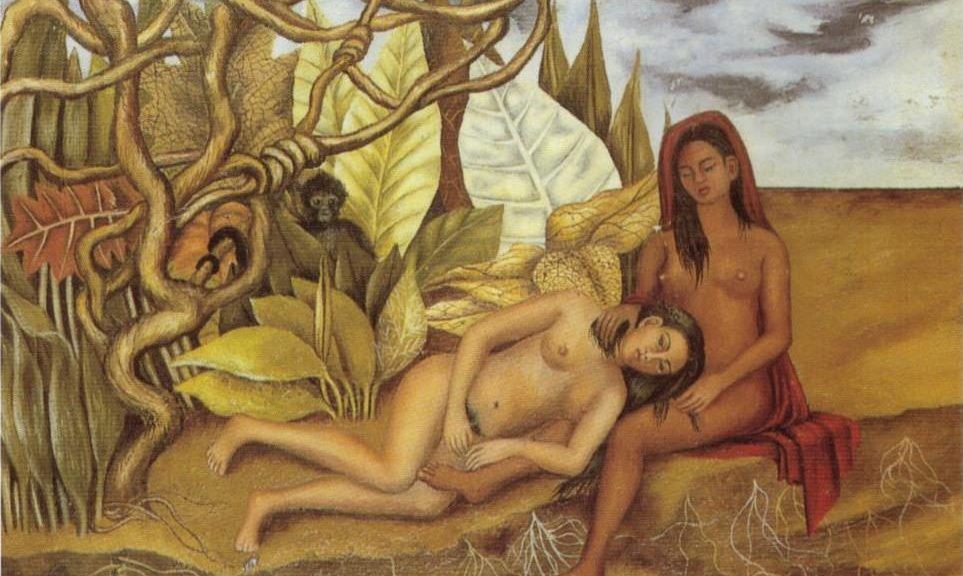
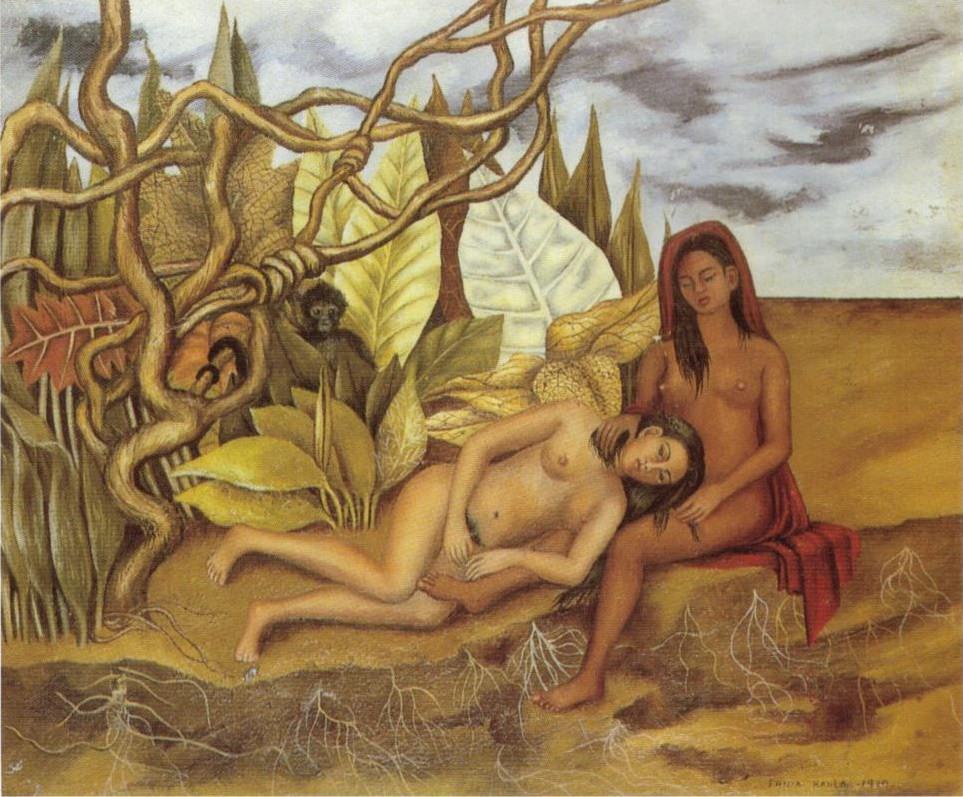
Featured Artwork: Two Nudes in the Forest (The Earth Itself)
two-nudes-in-the-forest-the-earth-itself

Date and location: 1939 in Mexico

Media: Oil on metal

Significance to Queer Art History:
This painting was originally created as a gift for Kahlo’s intimate partner, Delores del Rio, who was a popular Mexican actress in the 1920s-30s.

Symbolism:
The two women symbolize feminine sexuality as well as Frida’s dual identities comforting one another as European (signified by the figure with light skin) and Mestiza.

The painting also contains a monkey (a common symbol in Frida’s paintings and life as she owned several spider monkeys.) Monkeys, however, are also common symbols for sin and sexual promiscuity.

Resources & Further Reading:

“Biography of Frida Kahlo.” Biography | Frida Kahlo. Accessed April 13, 2017. https://www.frida-kahlo-foundation.org/biography.html.

Saslow, James M. Pictures and Passions: A History of Homosexuality in the Visual Arts. New York, NY: Viking, 2000. 237-38

“Two Nudes in the Forest (The Earth Itself).” Frida Kahlo: Paintings, Biography, Quotes. Accessed April 13, 2017. https://www.fridakahlo.org/two-nudes-in-the-forest.jsp.